I wanted to work with immigrant women who had the potential to lead, honing their writing skills in English. Elizabeth Semmelhack, Senior Curator of the Bata Shoe Museum, wanted to create a small exhibition featuring ‘the shoes that brought me to Canada’. We met at a dinner party. Our two ideas came together with a private sponsor and The Shoe Project was born.
Every Thursday last fall I met with twelve women from 18 to 60 who have come to Toronto from the Ukraine, Columbia, and many places in between. Elizabeth opened the rich storage vaults of the Bata and spoke of the cultural significance of shoes. I brought tea, and various members brought cookies. We talked about writing and we talked about immigration. We laughed over expressions using shoes that are common in many languages: ‘waiting for the other shoe to drop’ was one that puzzled almost everyone. ‘Filling someone’s shoes’ and ‘walking a mile in his shoes’ seem universal. Shoes are really quite profound: intensely personal, they speak of geography, weather, work, religion, and gender. Actually, there is very little that shoes DON”T speak about.
The women all found that they had a shoe-inspired tale. Writing their stories in 800 words was one thing. Providing a 100 word caption for an item on display in a showcase was even harder. One woman’s story is about being smuggled across the border from Eritrea in a pair of Nikes. Another wrote about her terror donning ski boots to take the ultimate test, sliding down on sticks down a hill in the Canadian Rockies. Another brought the tiny Gerber baby shoes her daughter wore when they first touched down in Canada from Pakistan.
By the end of eight weeks each member had written a personal essay and provided the footwear to match. The ‘snapshot’ exhibition where you can see their writing and their shoes opens Feb 9th. The Shoe Project continues this winter, with its members reaching out to help more women in their shoes.
KATHERINE GOVIER’S LATEST NOVEL IS THE GHOST BRUSH (HarperCollins.ca)
www.govier.com
www.theprintmakersdaughter.com
Thursday, January 26, 2012

Wednesday, January 25, 2012
Why is Family Literacy so important?
On January 27th, we celebrate Family Literacy Day in Canada. It's a national awareness day initiated by ABC LifeLiteracy Canada , to bring light to the importance of family literacy.
Today, I think we focus a lot on our children's literacy more than our own (as parents), and yet it's something that we should continue throughout of life. On the STELLAA website, we list 10 Ways to Celebrate Family Literacy Day, but you can definitely continue to do these daily. Literacy is not only about reading and writing. It's about growing your ability to learn, and we learn everyday. In everything we do, there is an aspect of learning. And thus, the importance of literacy.
It's never too late to start a new activity to build your literacy skills as a family. I have small children and so our literacy focused activities include visiting the library on a weekly basis (even on a busy day, I can't really avoid it as it's on my way to my son's school and I don't remember a day when he didn't ask to go to the library!) bedtime stories, read-a-longs at the library, and author events like the Children's Story Jam by Small Print Toronto. We've also started to play board games and do family puzzles. Some well-known board games that help children develop their literacy skills (while you refresh yours) include
Today, I think we focus a lot on our children's literacy more than our own (as parents), and yet it's something that we should continue throughout of life. On the STELLAA website, we list 10 Ways to Celebrate Family Literacy Day, but you can definitely continue to do these daily. Literacy is not only about reading and writing. It's about growing your ability to learn, and we learn everyday. In everything we do, there is an aspect of learning. And thus, the importance of literacy.
It's never too late to start a new activity to build your literacy skills as a family. I have small children and so our literacy focused activities include visiting the library on a weekly basis (even on a busy day, I can't really avoid it as it's on my way to my son's school and I don't remember a day when he didn't ask to go to the library!) bedtime stories, read-a-longs at the library, and author events like the Children's Story Jam by Small Print Toronto. We've also started to play board games and do family puzzles. Some well-known board games that help children develop their literacy skills (while you refresh yours) include
- Monopoly Jr.--helps with development of social skills, colour recognition, reasoning, reading and math skills
- Scrabble Jr.--develops literacy and language skills
- Boogle Jr.--helps with letter recognition, words, spelling, printing, and matching skills
- Zingo--fosters matching and reading skills, quick thinking
- Junior Labyrinth--helps with the development of spacial relations
It's a great way to spend an afternoon with the family...not to mention quite nice on the wallet! Other than the above mentioned learning opportunities, board games help your child calm their erratic energy into a more mature and sociably accept personality.
This Family Literacy Day, do something as a family to encourage and foster literacy and continued learning. We'd love to hear what you've done! Please comment below with any additional ideas!
By Joanna Ferensowicz, President, STELLAA
Wednesday, January 11, 2012
Sharing the Joys of Reading
I think I was born an avid reader. I will read anything and everything: books, magazines, comic books, cookbooks, poetry, fiction, mysteries, nonfiction, cereal boxes… Whatever has words on it is fair game.
I love being able to lose myself in a book and enter a different world, or to read a poem that paints a vivid image or provokes a feeling, or to discover something about an intriguing person in their biography.
But for some (like me), sharing a love of reading with someone else makes it even more enjoyable. What fun to talk about a book you love with a friend, comparing your likes and dislikes, or to write a few words in a book blog and have a discussion there with people you don’t even know! And of course, nothing compares with listening to a favourite story read aloud.
My first memory of being read to was from our battered set of Encyclopedia Brittanica. It had a whole section on fairy tales and I particularly remember Rumpelstiltskin. I can still see the wonderful line drawings that accompanied that fantastic story, showing him stomping off into the forest, never to be heard from again! My husband and I used to read to each other sometimes, and later as a new mother, one of my greatest joys was reading to my young son. We read to him every day, any time of the day or evening, and of course at bedtime without fail. That time for the three of us was very precious. Nobody wanted the story to end!
More recently, we read aloud to my mother-in-law as she got to the point of not being able to read or do much for herself. Although she virtually stopped speaking, she enjoyed it when we read to her and would nod or smile to tell us to keep going. Sometimes I would knit and she would watch me as we listened together to a familiar tale. We couldn’t always tell whether she understood the story or simply liked listening to our voices, but that didn’t really matter. It was a cozy way of spending time with each other, connected somehow through the book we shared.
A more active reading experienced is achieved by participating in a book club. I joined the one at the local public library and it is phenomenal. Reading a book for a book club is a different experience from simply reading for your own pleasure. After the quiet, introspective endeavour of reading the book on your own, you now enter a more dynamic phase. At my book club, there is heated debate and argument, questioning of viewpoints, agreement about some things, and strong disagreement about others. It is a lively two hours of discussion, discovery, laughter, and robust opinions. Our bond is the love of reading, but we represent different ages and stages in life, various types of careers, and several cultures and countries. Each of us brings a unique perspective to the table and adds to the richness to be found in the book. At the end of the session, we sometimes realize that our viewpoint has altered somewhat. How gratifying to know that we are gaining something from these meetings, however intangible that may be.
There are so many casual, day-to-day ways of sharing a good read. My son and I like some of the same authors, and are hooked on a couple of mystery writers. It’s hard to wait till the other one is finished the book before making comments. We are dying to find out what the other thought about the implausible plot, or the interesting new character that was introduced. My sister and I talk about books often through email, and I sent her a special book for Christmas. We are going to read it at the same time so we can discuss it as we go along. And of course I chat about books with my friends all the time and we often exchange books. So many ways to enjoy reading and many memories associated with it.
One especially fond memory is of visiting my in-laws when our son was small. We would sit in the family room after supper, all reading, or doing crossword puzzles. It was very quiet, except for my mother-in-law’s desultory comments about newspaper articles, or our occasional (unnecessary) contribution to my father-in-law’s cryptic crossword. But often we would simply sit together, reading in companionable silence.
A bond is formed through reading, a relationship with the author, or a fellow reader, that is unique. The exchanging of ideas, in whatever format, creates connections. What greater benefit could there be than to connect with another person, in whatever way that takes place?
Thanks to S.T.E.L.L.A. for the opportunity to share my love of reading with others. I am on twitter @jaduperreault and write a book blog where I review fiction, a bit of nonfiction, and the occasional poetry collection: Bookdiscovery-jeanne.blogspot.com
Tuesday, January 10, 2012
I am a Book Snob Hypocrite! By @Chickymara
I’m reading a really great book. Actually, its the third book in a trilogy. I read the first two books each in three days, and now I’m on the third. This trilogy is not what you’d call literary fiction. But, its got amazing characters and an engaging story. A friend of mine recommended that I read the books. When she asked me what I thought, my answer, I’m ashamed to admit, was, ‘Well, the writing isn’t that great, its kind of junky.’ I hastened to add, ‘But the story is really good so I’m loving it.’ Her answer? ‘Oh, funny. Only you would say that.’
Have I been a participant in book snobbery once again? Although as the perpetrator this time?
I’ve written before about this book snobbery, which is a condition where one judges others by the quality and genre of the words that they read. I was first really confronted personally by book snobbery when I was ‘judged’ by someone who tossed off the titles of arguably classic yet intimidating (and possibly mind numbing) tome by another book-lover, and who most certainly was horrified by my love of British Chick-Lit.
And here I was, doing something that I’d hated myself: clarifying or quantifying the value of a book.
I was at a literary festival (The Toronto Word on the Streets) in Toronto in September, and I was talking to one of the authors that I met about my son, who is a huge reader. I was bemoaning the availability of good reading for advanced tweens who don’t like vampires. I mentioned that my son loves James Patterson, a very prolific and commercially successful writer. And this author, who himself is extremely successful and commercial, made a face and said something to the effect of, ‘But, his writing. Meh.’ And I thought, ‘But the kid is reading...’
Sound familiar? Yep, book snobbery at work. And almost word-for-word what I said to my friend about the novels that she recommended to me. Am I a hypocrite?
I’ve always said that I like to read from a variety of genres, styles and authors. In fact, I really like to alternate my literary fiction with lighter fare. So, why did I feel the need to deride a book that I actually was enjoying? I’m not really sure. My friend is more of a paperback gal, so I wasn’t trying to impress her. Was I being a snob or just honest? And if it was the latter, which I’m 99% sure it was, did I need to tell her that I thought her new favorite book was sorta badly written?
I truly believe in self-reflection and improvement. And so, I will try not to judge a book by its innards. But, rather, I will rate it by how it resonates with me. How it makes me feel, engages me, and lives in my imagination. The words will become the vehicle, and not something to critique. Especially, because I’m pretty sure I can’t do any better (and we all know, if you can’t do, don’t critique. Right?
By @Chickymara
Have I been a participant in book snobbery once again? Although as the perpetrator this time?
I’ve written before about this book snobbery, which is a condition where one judges others by the quality and genre of the words that they read. I was first really confronted personally by book snobbery when I was ‘judged’ by someone who tossed off the titles of arguably classic yet intimidating (and possibly mind numbing) tome by another book-lover, and who most certainly was horrified by my love of British Chick-Lit.
And here I was, doing something that I’d hated myself: clarifying or quantifying the value of a book.
I was at a literary festival (The Toronto Word on the Streets) in Toronto in September, and I was talking to one of the authors that I met about my son, who is a huge reader. I was bemoaning the availability of good reading for advanced tweens who don’t like vampires. I mentioned that my son loves James Patterson, a very prolific and commercially successful writer. And this author, who himself is extremely successful and commercial, made a face and said something to the effect of, ‘But, his writing. Meh.’ And I thought, ‘But the kid is reading...’
Sound familiar? Yep, book snobbery at work. And almost word-for-word what I said to my friend about the novels that she recommended to me. Am I a hypocrite?
I’ve always said that I like to read from a variety of genres, styles and authors. In fact, I really like to alternate my literary fiction with lighter fare. So, why did I feel the need to deride a book that I actually was enjoying? I’m not really sure. My friend is more of a paperback gal, so I wasn’t trying to impress her. Was I being a snob or just honest? And if it was the latter, which I’m 99% sure it was, did I need to tell her that I thought her new favorite book was sorta badly written?
I truly believe in self-reflection and improvement. And so, I will try not to judge a book by its innards. But, rather, I will rate it by how it resonates with me. How it makes me feel, engages me, and lives in my imagination. The words will become the vehicle, and not something to critique. Especially, because I’m pretty sure I can’t do any better (and we all know, if you can’t do, don’t critique. Right?
By @Chickymara
Wednesday, December 28, 2011
Social media...is it the new philosophy for kids and teens?
Philosophy is about discussion, questioning and experimenting with ideas. Social media outlets let us and our kids join in discussions on topics that are of interest to them. With social media we are able to question others' thoughts and ideas. We are able to express our ideas and hear others' opinions of our ideas.
Now the question is, can we use this new social phenomenon to expand literacy and learning skills in kids and teens. I don't know a teen that doesn't use the Internet. And most are using some form of social media. They are expressing their ideas and therefore, in some form or another, developing philosophical skills that help, in turn, develop literacy skills.
With social media being a medium of free expression, we are bombarded with so much information and must use and therefore, build our information processing skills. When reading and writing, whether for pleasure or purpose, we use the same info processing skills. We then enquire, reason and creatively think of our own 'philosophy' on the topic.
So how can we integrate social media into teaching literacy, critical thinking and philosophy to kids and teens?
By Joanna Ferensowicz, President, STELLAA
Now the question is, can we use this new social phenomenon to expand literacy and learning skills in kids and teens. I don't know a teen that doesn't use the Internet. And most are using some form of social media. They are expressing their ideas and therefore, in some form or another, developing philosophical skills that help, in turn, develop literacy skills.
With social media being a medium of free expression, we are bombarded with so much information and must use and therefore, build our information processing skills. When reading and writing, whether for pleasure or purpose, we use the same info processing skills. We then enquire, reason and creatively think of our own 'philosophy' on the topic.
So how can we integrate social media into teaching literacy, critical thinking and philosophy to kids and teens?
By Joanna Ferensowicz, President, STELLAA
Tuesday, December 20, 2011
5 reasons to give books as gifts
We happen to think that books make great gifts all year round, but seeing as we are right in the middle of the holiday season, we thought we'd give you some great reasons to give books as gifts to everyone on your list this year:
1. Compared to many of the other gift options out there, books are pretty inexpensive. Especially when you consider that books not only give you happiness while you're reading them but also long after you've turned that last page.
2. Choosing the right book to give as a gift takes real thought and attention. Who wouldn't want that over a gift card or something equally impersonal?
3. Books are really easy to wrap! It's a small thing, but it counts.
4. Giving a book that you've read to a friend or family member means you have the perfect excuse to get together again and discuss it.
5. You can buy books online, at independent bookstores, and at larger bookstore chains. You can even gift an eBook by simply purchasing the book and sending it in an email. Buying books has never been easier!
Will you be giving any books as gifts over the holidays?
1. Compared to many of the other gift options out there, books are pretty inexpensive. Especially when you consider that books not only give you happiness while you're reading them but also long after you've turned that last page.
2. Choosing the right book to give as a gift takes real thought and attention. Who wouldn't want that over a gift card or something equally impersonal?
3. Books are really easy to wrap! It's a small thing, but it counts.
4. Giving a book that you've read to a friend or family member means you have the perfect excuse to get together again and discuss it.
5. You can buy books online, at independent bookstores, and at larger bookstore chains. You can even gift an eBook by simply purchasing the book and sending it in an email. Buying books has never been easier!
Will you be giving any books as gifts over the holidays?
Monday, December 12, 2011
Book Sharing
My house is covered from end-to-end in books. As I’ve said in previous posts, to me, the best way to get kids reading is to make the books readily available to them. If something is all around, you’re just bound to love it, right? It’s true. Sort of. My kids do like to read, although they go through phases with their attraction to reading, which is partially caused by distractions such as Facebook, hacking each others computers, or just being a teenager. What I do notice, though is that they don’t treasure or revere the actual physical objects called books like I did as a child. I still have some of the books that I loved, even now, 30 years later. When I see them, I smile. There are memories associated with them. Now, maybe it’s just me, and my attachment to things that are meaningful, but I like to keep my books forever. I was devastated when my parents accidentally sold a box of my childhood picture books at a garage sale. And I still think about my ‘babies’ that were donated by my husband after we moved into our current home. Maybe I’m selfish, or even a hoarder, but I like to keep my books all to myself, even those I have no intention of re-reading. (I do share if the borrower promises to bring the book back forthwith.) After all, the stories are mine, right? Associated with those pages are my memories and the vivid imaginary experiences that I’ve had with the characters. My kids, however, are very happy to clear their bookshelves, either sharing the books around the house with a sibling, giving them to friends or their cousins, or in the case of my youngest, donate them to his school library. As he said, ‘These are books I don’t want anymore. But, they are titles (I swear he used the word title-he’s gifted) that other kids like and are in demand with the school library. I already spoke to the librarian.’ I sift through their picture books alternately smiling and sobbing as I reflect on the memories contained therein. I think about warm, cozy story time and soft, downy, post-bath time heads snuggled against my chest as I read them about the latest adventures. But, they are just ready to move on. They seem to be able to separate the object (book) from love of the story. I can’t decide if it saddens me or baffles me. Maybe I’m selfish or just sentimental. Books are for everyone. They bring people together. My kids understand that these stories are meant for sharing. Instead of squeezing their bookshelves ever tighter, double stacking and haphazardly piling, my children want to pass on their favorites to others who might enjoy them. I’m starting to think that those kids have got it right and its time to overcome my possessiveness over my paperbound bits of happiness. I think I should begin to follow their lead starting with this holiday season. I encourage you all to share the gift of reading by dropping off a box of books to STELLAA, to make a donation, or follow my son’s lead, and give the books to your local school library, shelter, or even hospital. I hope that this New Year brings you health, happiness, and the prosperity that comes from within.
Wednesday, November 30, 2011
Blog Profile: Sound It Out
Dr. Joanne Meier has worked in the fields of early childhood and reading education for over 20 years. And on top of that she's also a mom raising her very own readers at home. Needless to say she has a lot of insight and helpful advice to share, and that's why we are loving her blog, Sound It Out. Reading Joanne's posts every week is a great way to learn from all her years of experience.
Here just a few of our favourite posts from Sound It Out:
This post is all about what we should do as parents and educators to help motivate children once they get the books in their hands, which is a very important step in promoting literacy.
A great post about how to encourage non-readers to read the books they have been assigned to read. Anyone who has attempted this knows it can be tough, so Dr. Meier's tips are much appreciated.
In this post, Joanne explains how picture books are actually the perfect supplement to an existing science program. For example, the colourful pictures and graphics in picture books can help explain abstract ideas to kids.
STELLAA would like to profile a new blog that deals with literacy, education, and/or books every month. Make sure to leave us a comment with any blogs that we should check out!
Saturday, November 19, 2011
Children's Books About Africa
Kids are naturally inquisitive and curious, so why not teach them about different cultures while they are still young and eager to learn? We've chosen three acclaimed children's books about Africa that will get kids interested in African culture and heritage.
We'd also love to hear some suggestions of other great children's books about Africa, so please leave us a comment with your favourites!

We All Went on Safari by Laurie Krebs (ages 5+)
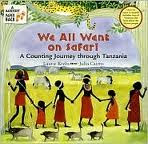 Join Arusha, Mosi, Tumpe and their Maasai friends as they set out on a counting journey through the grasslands of Tanzania. Along the way, the children encounter all sorts of animals including elephants, lions and monkeys, while counting from one to ten in both English and Swahili. The lively, rhyming text is accompanied by an illustrated guide to counting in Swahili, a map, notes about each of the animals, and interesting facts about Tanzania and the Maasai people. - Amazon.com
Anansi the Spider: A Tale from the Ashanti by Gerald McDermott (ages 4+)

We'd also love to hear some suggestions of other great children's books about Africa, so please leave us a comment with your favourites!
Bringing Rain to Kapiti Plain by Verna Aardema (ages 5+)
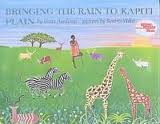
The story of how Ki-pat ingeniously brings rain to the arid Kapiti Plain. "Cumulative rhyming tale with the rhythm and repetition of The House That Jack Built . . . Illustrations are stylized, simple, and dramatic."- School Library Journal.
Anansi the Spider: A Tale from the Ashanti by Gerald McDermott (ages 4+)

Anansi the Spider is one of the great folk heroes of the world. He is a rogue, a mischief-maker, and a wise, lovable creature who triumphs over larger foes.
In this traditional Ashanti tale, Anansi sets out on a long, difficult journey. Threatened by Fish and Falcon, he is saved from terrible fates by his sons. But which of his sons should Anansi reward? Calling upon Nyame, the God of All Things, Anansi solves his predicament in a touching and highly resourceful fashion.
In adapting this popular folktale, Gerald McDermott merges the old with the new, combining bold, rich color with traditional African design motifs and authentic Ashanti language rhythms. - Amazon.com
Friday, November 11, 2011
Instilling a love of reading in kids
A lot of my friends have complained to me over the years that their kids don't like to read and that they never pick up a book voluntarily. I’ve never had that problem. In fact, I have the reverse problem. My kids love to read. Its a very expensive habit to, but one I happily support.
Since they were small, my kids have loved books and the stories they contain. As much as they begged for a new toy, they asked for books, books, and more books. They were insatiable. ‘Just one more tory.’ Was the refrain when they were small, and ‘Just 5 more minutes’ the request as they grew.
The speed at which they consumed the words was fast and furious. New material was always on the radar. In fact, the desire for a new read went as far as them guessing my password for the online bookstore and going in and dropping books in my shopping basket.
So, how did I create this love of words, this culture of reading in my house? I don't know that I did anything special, nor do I have a magical solution. I’m not sure that you can force your kids to be good or enjoy something for which they have no interest or inclination. For example, I'm wickedly bad at any and all sports, except yoga, which isn't really a sport. But, my parents did try to encourage the growth of an interest by making athletic pursuits available. They signed me up for lessons in multiple activities, from dance to skating, gymnastics, to baseball. And, I just sucked. At all of it. And I hated it. But, I remember trying, and I received the message that physical activity is important. (In case you’re wondering what I was doing when everyone else was running around? I was reading. All the time. And far into the night.)
I believe that an appreciation for reading, if not a love for it can be encouraged in the same way. What are some things I did when my kids were small to encourage reading and set the stage for literacy as they grew?
(I'll caveat that I was lucky and my kids seemed to have an affinity for reading. When my daughter was four, we 'caught' her reading to a classmate, even though nobody knew she could read.)
• We read to our kids everyday. And not just at bed time. Anytime was story time if there was a book handy.
• Books were everywhere. I had a little bookshelf in the family room/ playroom as well as each child had a bookshelf in their room. The bookshelves were at child level so they could easily access them.
• They kids saw me reading. All the time.
• We made regular trips to the bookstore and library. Long half day trips. Picking a book was serious business. I rarely said no to the purchase of a book, while I did for toys and video games.
• Holiday gifts ( we celebrate Chanukah) and birthdays always included books or gift certificates for the book store.
• Books were part of the ceremony of living. We had books for holidays, birthdays, special events. We had books for feelings, and for good days, and even for bad days. Books were your friends.
So, those are some of my tips to encourage a love of literacy and reading in your home. What are some things you have done to encourage a love of reading in your home?
By @chickymara
Wednesday, October 26, 2011
Book Character Costumes for Kids
Halloween is right around the corner so we thought it was the perfect time to give you a few ideas for some costumes based on popular book characters.
- Harry Potter: What list of book character costumes would be complete without this famous wizard? You'll need a black robe, Gryffindor (or something similar) patch, and of course those trademark round glasses.
- Madeline: Always remember to walk in two straight lines! For the perfect Madeline costume you'll need a blue coat with a white collar, a yellow hat with a black ribbon, and a red scarf.
- Sherlock Holmes: Perfect for inquisitive children, Sherlock Holmes needs a trench coat, a hat (also known as a thinking cap), a wooden pipe, a magnifying glass, and a mystery to solve, of course!
- Alice in Wonderland: The perfect Alice costume is made up of a blue dress with a white pinafore or apron, white knee-high socks, and some black shoes. Bonus points if you can get a hurried White Rabbit to follow her around!
- Olivia: The lovable, optimistic pig that steals your heart is a pretty simple costume. Olivia wears a red dress with some stripped legwarmers, and don't forget the cute pink pig ears to top it all off.
Wednesday, October 19, 2011
Gaming and Literacy
“When people learn to play video games they are learning a new literacy.” - James Paul Gee, linguist and professor of literacy studies at Arizona State University
According to a recent article on the website MindShift, gaming should be considered the new essential literacy.
When kids play video games, they're not only having fun but they're also learning problem solving skills, trial and error, and that it takes practice to get good at anything. As the article points out, "a critical part of being literate in the digital age means being able to solve problems through simulations and collaboration."
Many parents dismiss video games as simple, mindless entertainment, which can lead to arguments and frustration. So what would happen if we were to change our way of thinking about gaming? Would our kids benefit if we were to shift our view to see gaming as a more productive pastime? If, as the article suggests, gaming teaches children important life lessons and skills, it might be something worth considering.
If you're interested in learning more about the connection between gaming and literacy, here are a few more articles on the topic:
How Games Can Influence Learning
Five Reasons Why Video Games Power Up Learning
The Literacy of Gaming: What Kids Learn from Playing
Monday, October 10, 2011
Don’t be a book snob. Reading is Reading.
Snob: n [snob]
a person who believes
himself or herself an expert or connoisseur in a given field and is
condescending toward or disdainful of those who hold other opinions or have
different tastes regarding this field: i
I was at an event for the book community. It
was a volunteer thank day you for those who were helping out for an upcoming
event, all rampant book lovers. Some
were actually part of the book community (privileged to work at publishing
houses, as book agents, etc.), while others, like me were merely avid readers
(and most likely aspiring book-aternity insiders.)
I was getting to know one of the other
volunteers, chit chatting away, and I mentioned a few of the books that I’d
read in the months prior. She looked at
me askance, and I could tell by her face that she wasn’t impressed. Then, she asked me if I’d read a book. It was Chekhov, or the Odyssey, or another
tome like that. A volume that was really smart, most possibly obscure. So
obscure, and written as a long poem, about someone’s endless journey, that I
cannot (probably because of a mental block created to avoid boredom), remember
for the life of me who the author is.
At that moment, though, for one single drawn
out breathe, I felt ashamed of my literary, book-obsessed self. Because I hadn’t read this one book. Because this one lady disapproved of my taste
and was able to cause me to doubt my valued membership in the ‘Read-a-thon
Club’. Me, who read adult novels at the
age of 9. Me, who read Pygmalion, Jane
Eyre, and Wuthering Heights FOR FUN when I was in High School. Me, who has read over 100 books already this
year.
What would a comment, a look, an intimation of
‘not-good-enoughness’ do to someone who is just falling in love with reading;
to an adult who has just gained their literacy or a child with dyslexia
struggling to read.
I know one boy who only reads anime
comics. A friend of mine gets her
reading on with People Magazine. My
husband reads the newspaper, and magazines, blogs, and websites related
specifically to his interests. Should I
judge them because they’re not reading actual books, or what I think are
intelligent or ‘worthy’ literature?
Should I be a ‘book snob’?
This is the way I look at it. Instead of worrying
about, and even judging, what folks are picking up to read, why don’t we just
encourage the simple act of putting letters together to make words, words to
sentences, sentences to paragraphs, and so forth. It doesn’t matter whether its
a sign, a flyer, a book, or even subtitles in a movie. Every time someone enjoys the written word, a
literacy star is born. Instead of book
snobbery, why don’t we promote book love and literacy? I mean who cares what
someone ELSE is reading? I know I don’t.
Wednesday, October 5, 2011
How to get boys to read
Since boys
can sometimes be reluctant readers, here are a few ways you can encourage them
to read and improve their literacy skills:
- Let him
choose books, magazines, or graphic novels on subjects and genres he is
interested in.
- If he seems
more interested in sports than anything else, you can always pick up a
non-fiction book about that sport or a biography on his favourite athlete.
- When
visiting museums, zoos, and aquariums, why not end the day with a stop in the
book section of the gift shop. Let him choose a book on something he saw and
would be interested in learning more about.
- Both
boys and girls will be more interested in reading if they see you doing it. The
more books and magazines you have around the house the better.
Wednesday, September 28, 2011
5 Ways to Raise a Reader
Here are five ways to motivate your
children to read and to become lifelong readers.
1. Get into the habit of reading to your
kids as early as possible. Whether you choose to start before the baby is even
born or at a few months old, the earlier you make reading a part of your
child’s daily schedule the better.
2. Be a reading role-model: If your kids
see you reading as a hobby, whether it’s books, magazines, newspapers, or
e-books, they’ll want to follow your lead.
3. Visit bookstores and libraries with your
kids often and encourage them to find books on subjects they’re interested in. Get
them their own library card, and while you’re there make sure to pick up a book
for yourself!
4. Make the stories they’re reading come
alive by planning events and activities that go along with the theme of the
book. Making crafts, dressing up in costumes, and visiting locations that are
similar to those in the book will make it more exciting for both you and your
kids.
5. If the only time kids read is when they
are assigned books as homework, is it any wonder they don’t enjoy it? Encourage
your kids to read just for pleasure. If they can experience reading as a fun
activity they will be far more likely to carry it into adulthood.
Sunday, September 11, 2011
Welcome to my world of books! (By ChickyMara)
Welcome
to my world of books. And thanks for
coming. I was thrilled when STELLAA
asked me to join their group of bloggers and to share my love of reading,
books, and the power of words. It’s hard to capture the passion and love that I
feel for books.
Aside:
You’ll notice that I don’t use the word literature, because sometimes what you’re
reading isn’t actually ‘literature’ in the true definition of the word. (Everyone
has their secret pleasures).
A
book can be many things: an escape, a way to make something better, a world other than your own. Sometimes a book can do much more than just
entertain-it can educate, it can train, it can transform.
I am a huge believer in literacy, and the
power of the written word. Reading can take many forms: books, magazines, comics, even signs and
pamphlets. It doesn’t matter where or
what you read. What matters is that you
have the opportunity to stretch your mind and take it to other places, to gain
the information you need, or even to find your way.
STELLAA is working to make that happen.
By making books available to those who would not have access to them, they are
providing them the opportunity to move beyond, to gain the knowledge, to
grow. All people- children and adults,
rich or poor, should have the opportunity to develop a love of the written
word.
I’m not an activist. I will write about what matters to me about literacy and how it fits into the greater scheme of life. My feelings towards the importance of reading are organic. They come out of what I’ve seen words and knowledge accomplish; how they have enriched my life and the lives of my children.
I’m not an activist. I will write about what matters to me about literacy and how it fits into the greater scheme of life. My feelings towards the importance of reading are organic. They come out of what I’ve seen words and knowledge accomplish; how they have enriched my life and the lives of my children.
I hope you enjoy taking this journey
with me as we explore the power of the book together. I look forward to creating and debating. You don’t always have to agree with me, and I
welcome constructive comments and suggestions.
Let’s do this!
Thursday, November 25, 2010
Connections Made at The Word On The Street Toronto, Sept. 26, 2010
At the Word on the Street Toronto Festival, we were able to bring more awareness to STELLAA's mission and work. We connected with hundreds of people. We were also fortunate to make connections with several organizations and professionals, which STELLAA is preparing to work with and/or accept donations from. STELLAA can't wait till next year's WOTS!
Subscribe to:
Posts (Atom)